
RFP Software for Enterprise B2B Sales: RFP & RFI Responses with AI
RFP software is the system of record for bid responses: it stores approved answers in a searchable content library, drafts each RFP or RFI reply from that library with AI, routes sections to the right reviewers, and exports the response in the format the buyer demands. Iternal's Waypoint adds a version that runs on your own network.
What is AI RFP Response Software?
Transform how your team creates winning proposals
The Revolution in Proposal Management
AI RFP response software is transforming how organizations respond to Requests for Proposals (RFPs), Requests for Information (RFIs), and other enterprise B2B sales documents. Instead of spending weeks manually searching for content and crafting responses, teams can now use AI proposal writing tools to generate first drafts in minutes while maintaining brand consistency and accuracy.
Modern AI proposal automation software combines natural language processing, semantic search, and generative AI to understand RFP requirements, match them with your organization's knowledge base, and produce polished, compliant responses. This technology enables proposal teams to respond to more opportunities while improving win rates and reducing costs by up to 93%.
Why AI is Changing Proposal Management
The proposal management industry is experiencing a fundamental shift. According to industry research, organizations using AI-powered RFP tools are seeing dramatic improvements in their proposal processes:
- 17X faster proposal creation - What once took 3-6 weeks now takes 2 days
- 80% reduction in manual work - AI handles repetitive copy-paste tasks
- Higher win rates - Better quality responses with consistent messaging
- 3X more proposals submitted - Teams can respond to more opportunities
- Improved compliance - AI ensures all requirements are addressed
Understanding RFPs, RFIs, and Enterprise Sales Documents
A comprehensive guide to B2B procurement documents
What is an RFP (Request for Proposal)?
A Request for Proposal (RFP) is a formal procurement document issued by an organization seeking suppliers to provide goods or services. The RFP outlines project requirements, evaluation criteria, timeline, and budget parameters, requesting detailed proposals from qualified suppliers.
Agencies and companies writing one rather than answering one can start from the AI project RFP template, which sets out the sections an AI solicitation needs. RFPs are critical in B2B sales because they represent significant revenue opportunities. A well-crafted RFP response demonstrates your organization's capabilities, differentiates you from competitors, and builds trust with potential customers. This is why writing proposals with AI has become a competitive advantage - it allows teams to submit more responses of higher quality.
Key components of an RFP typically include:
- Scope of Work: Detailed requirements and deliverables expected
- Technical Requirements: Specifications every bidder must meet
- Evaluation Criteria: How proposals will be scored and compared
- Pricing Structure: Required format for cost proposals
- Compliance Requirements: Certifications, security standards, legal terms
- Timeline: Submission deadlines and project milestones
What is an RFI (Request for Information)?
A Request for Information (RFI) is an earlier-stage procurement document used to gather information about potential suppliers and solutions before a formal RFP is issued. RFIs help organizations understand the market landscape, identify qualified suppliers, and refine requirements for subsequent RFPs.
RFIs are typically shorter and less detailed than RFPs, focusing on supplier capabilities, experience, and general solution approaches. AI-powered proposal tools excel at RFI responses because they can instantly surface relevant case studies, company credentials, and differentiators from your knowledge base.
Most RFIs will include:
- Requirements outline with goals and objectives
- Background information on the issuing organization
- Supplier qualifications and credentials desired
- Desired outcome information
- Evaluation criteria for shortlisting
- Submission deadline and format requirements
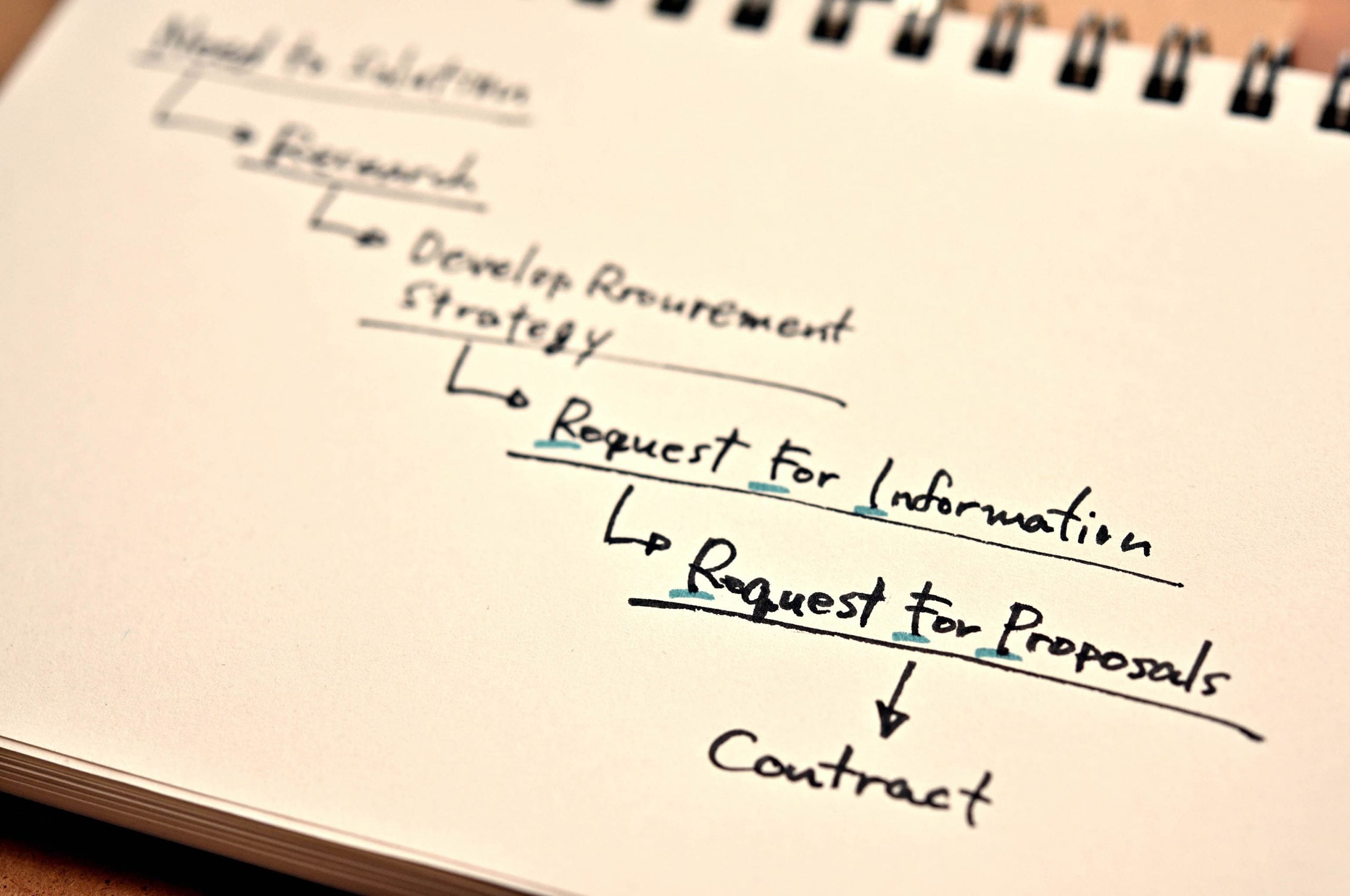
RFI First, RFP Second
The order is the whole point: the RFI narrows the field before requirements are fixed, and the RFP follows once they are, scored against published criteria and ending in an award. Answering the RFI well is what earns the RFP invitation; the RFI vs RFP entry sets out length, pricing and outcome side by side.
Other Enterprise B2B Sales Documents
Beyond RFPs and RFIs, enterprise sales teams must master several other document types. RFP software can help with all of these:
Most of this is still run by hand, question by question, in the week before a deadline. For more information visit the automating the manual document work page.
- RFQ (Request for Quote): Pricing-focused requests for standardized products/services
- Security Questionnaires: Detailed security and compliance assessments
- Due Diligence Documents (DDQ): Comprehensive supplier assessment questionnaires
- Statements of Work (SOW): Detailed project scope and deliverables
- Capability Statements: Company credentials and experience summaries
- Technical Proposals: Detailed solution architecture and implementation plans

How to Automate RFP Responses with AI
A step-by-step guide to implementing AI proposal automation
Step 1: Build Your AI Knowledge Base
The foundation of effective AI-drafted RFP responses is a comprehensive, well-organized knowledge base. This becomes the "brain" that powers your AI proposal writing capabilities. Governed corporate memory — see our guide to AI knowledge management — is what makes reusing prior answers fast and accurate.
What to include in your AI knowledge base:
- Previous winning proposals and responses
- Product and service documentation
- Case studies and customer success stories
- Technical specifications and architecture diagrams
- Security certifications and compliance documentation
- Company credentials and team bios
- Competitive differentiators and value propositions
- Pricing templates and approved discount structures
Iternal's IdeaFORGE platform uses patented IdeaBlock technology to organize this content into modular, reusable components that AI can intelligently assemble for each unique proposal.
Step 2: Import and Analyze the RFP
Modern AI RFP software can import RFP documents in various formats (PDF, Word, Excel) and automatically analyze them to:
- Extract all questions and requirements
- Identify compliance criteria and mandatory elements
- Flag potential risks or red flags
- Match requirements to your capabilities
- Support bid/no-bid decision making
This analysis typically takes minutes compared to hours of manual review, allowing your team to quickly assess opportunities and prioritize responses.
Step 3: Generate AI-Powered First Drafts
With your knowledge base established and the RFP analyzed, AI proposal writing tools can generate first drafts for each section. The best systems:
- Use semantic understanding to match questions with relevant content
- Maintain your organization's brand voice and terminology
- Cite sources and show confidence scores
- Flag gaps where human input is needed
- Generate multiple response variations for review
Remember: AI generates drafts, but human experts refine and approve. The goal is to eliminate repetitive work, not replace strategic thinking.
Step 4: Collaborate and Review
Writing proposals with AI is a collaborative process. After AI generates initial drafts:
- Subject matter experts review and enhance technical sections
- Sales teams customize messaging for the specific opportunity
- Legal reviews compliance and contractual language
- Pricing teams develop and validate cost proposals
- Executive sponsors provide strategic oversight
AI proposal platforms facilitate this collaboration with workflow tools, commenting features, and version control.
Step 5: Final Review and Submission
Before submission, RFP software can perform automated quality checks:
- Compliance verification: Ensure all requirements are addressed
- Consistency checking: Verify messaging alignment across sections
- Grammar and style review: Maintain professional quality
- Format validation: Confirm compliance with submission requirements
- Win theme alignment: Ensure key differentiators are highlighted


Best Practices for Responding to RFPs with AI
Maximize your success with AI-powered proposal automation
Build a Centralized Content Library
Create a single source of truth for all proposal-related content. Import previous responses, product documentation, security questionnaires, and sales collateral into a centralized RFP content management system. This intelligent knowledge base becomes the engine that powers every AI-drafted answer you submit.
Train AI on Your Organization's Data
When you automate RFP responses with AI, you need the system trained on your past bids, products and services, company information, and other relevant materials. Upload content to your AI knowledge library to prevent hallucinations and ensure accurate, brand-consistent responses.
Use AI for First Drafts, Humans for Strategy
RFP software generates first drafts of complex proposals in minutes. This frees your team to focus on strategic review, customization, and tailoring proposals to each client's specific needs rather than repetitive copy-paste work.
Leverage Semantic Search Technology
The best AI RFP software uses semantic search rather than simple keyword matching. This technology understands the true context of each question and retrieves the most relevant, accurate answers from your content library.
Implement Continuous Improvement Loops
AI tools should be regularly updated and trained on new data. Encourage collaboration between AI systems and human experts. Implement feedback mechanisms to continuously improve AI-generated content based on win/loss analysis.
Prioritize Security and Compliance
Proposals contain proprietary data, pricing strategies, and client information. Use enterprise-grade AI solutions with SOC 2, ISO 27001, and other security certifications. For maximum security, consider AirgapAI for 100% local AI processing with zero cloud dependencies.
Secure AI for Confidential Proposals
Protecting sensitive information in AI-powered proposal workflows
Why Security Matters in AI Proposal Writing
Proposals contain some of your organization's most sensitive information: proprietary pricing strategies, competitive differentiators, customer references, and technical architectures. When using AI to automate RFP responses, security must be a top priority.
Many cloud-based AI tools process your data on external servers, potentially exposing confidential information. This creates risks around data privacy, competitive intelligence leakage, and regulatory compliance violations.
AirgapAI: 100% Local AI for Maximum Security
For organizations with strict security requirements, AirgapAI provides a completely different approach to AI proposal writing. Unlike cloud-based AI tools, AirgapAI runs 100% locally on your own infrastructure with zero data transmission to external servers.
AirgapAI advantages for proposal teams:
- Complete Data Privacy: Your proposals never leave your network
- Air-Gapped Operation: Works without internet connection
- Compliance Ready: Meets strictest data sovereignty requirements
- No Data Mining: Your content is never used to train external models
- Enterprise Controls: Full administrative control over AI access and usage
AirgapAI is ideal for defense contractors, government suppliers, healthcare organizations, and any business handling sensitive proposal content. Combined with Blockify's 78X AI accuracy, it delivers enterprise-grade proposal automation without security compromises.
Security Certifications to Look For
When evaluating AI RFP software, confirm the provider holds the security certifications your bids are audited against:
- SOC 2 Type II: Security, availability, and confidentiality controls
- ISO 27001: Information security management standards
- FedRAMP: For federal government contractors
- HIPAA: For healthcare-related proposals
- GDPR Compliance: For European data handling
RFP Software Buyer Criteria
Six capabilities to test on your own bid before you sign anything
One approved content library
Every answer a reviewer has already blessed lives in one library, versioned, owned by a named person and dated. Ask how the library is imported from past bids, how duplicates are merged, and what happens to an answer when the product changes. A library nobody trusts turns back into copy-and-paste inside a quarter.
Drafting grounded in your own answers
The draft must be assembled from your library, with the source of each paragraph visible to the reviewer. Retrieval that reads the intent of a question beats keyword lookup, and a draft that cites nothing is a draft nobody can approve. Iternal grounds drafts in Blockify IdeaBlocks so each answer traces back to approved content.
Security posture and deployment model
Bids carry pricing strategy, staffing plans and customer references. Establish where the text is processed, which model sees it, how long it is retained and whether the provider trains on it. For teams under CMMC, ITAR or a data-residency clause, the only answer that survives review is processing that never leaves the network.
Export and submission-format compliance
A response that cannot be produced in the buyer's template is a no-bid. Check native export to the required Word, Excel and PDF forms, page and character limits, per-section numbering that matches the compliance matrix, and whether the export survives a portal upload without reformatting by hand.
Review workflow and audit trail
Subject-matter experts, legal, pricing and the capture lead all touch the same document. Look for section-level assignment, due dates, comment threads that resolve, and an audit trail that shows who approved which claim. Public-sector bids need that trail to answer a protest months after submission.
Content health and win/loss analytics
The library decays without measurement. Useful systems report which answers were reused, which were rewritten before submission, which questions had no answer at all, and how those patterns track against wins. That report is what tells the proposal lead where next quarter's content work goes.
RFP Software Compared: Which Category Fits Your Team
Four categories of RFP software, and the one question that decides between them
| Category | Approved content library | Grounded AI drafting | Compliance-matrix export | Runs on your own network | Best for |
|---|---|---|---|---|---|
| Dedicated RFP response platformsResponsive, Loopio | Yes, with answer owners and review dates | Yes, from the library you curate | Yes, matrices and buyer templates | No, multi-tenant cloud | High-volume teams whose content may live in a cloud platform |
| Proposal management suitesPandaDoc, Proposify | Templates and reusable blocks | Assisted, inside a template | Branded proposals, not matrices | No, cloud | Commercial proposals, quotes and e-signature |
| General-purpose AI assistantsChatGPT, Copilot, Gemini | No, context per prompt | Fluent but ungrounded | No, manual assembly | Cloud by default | Narrative drafting on top of a governed library |
| RFP software on your own networkIternal Waypoint with AirgapAI | Yes, as Blockify IdeaBlocks | Yes, traceable to its source block | Yes, buyer template and matrix | Yes, nothing leaves the network | Defense, government, health, data-residency clauses |
Whether your bid content is allowed to leave your network is what decides between these four categories. If it can be processed in a cloud platform, the established RFP platforms are the shortest path to a working answer library and a review workflow. If it cannot, the shortlist narrows to systems that draft and export inside your own network.
Dedicated RFP response platforms
Responsive and Loopio built this category. They are strong where most proposal teams hurt first: importing a questionnaire and splitting it into assignable questions, holding a large answer library with owners and review dates, and moving a 300-question response through subject-matter experts on a deadline. If your content can live in a multi-tenant cloud, start your shortlist here.
What to test on your own bid: how the importer handles a messy Excel compliance matrix, how quickly a new answer becomes the one the library returns, and what the export looks like against the buyer's template.
Proposal management suites
PandaDoc, Proposify and the quote-to-close tools are built for the commercial proposal: branded layout, pricing tables, e-signature and a clean buyer-facing reading experience. For a mid-market sales team sending twenty proposals a month, that is often the whole job.
They are lighter on the compliance side of a formal solicitation — long question matrices, per-section page limits, and the audit trail a public-sector award has to survive. Iternal keeps the library-management view of this work on the proposal management software page.
General-purpose AI assistants
A general assistant drafts fluent prose in seconds and costs almost nothing to try, which is why most proposal teams already use one. It is a real accelerator for narrative sections, executive summaries and rewriting a technical answer for a non-technical evaluator.
The limit is provenance. Without a governed library behind it, the model has no way to know which security certification you actually hold or which reference customer you are cleared to name, and a reviewer cannot trace a claim back to an approved source. Treat it as a drafting aid on top of a library, not as the library.
RFP software that runs on your own network
The categories above process your text in someone else's cloud. For defense and government bidders, health systems and any team with a data-residency clause in its own contracts, that is the point where the evaluation stops.
This is where Iternal fits. Waypoint assembles each response from your approved content, and with AirgapAI the drafting model runs locally on your own hardware, so the bid, the pricing and the reference customers never leave the network. Blockify IdeaBlocks keep each drafted paragraph traceable to the answer it came from.
Where to go deeper
If you are still designing the workflow rather than shopping for a system, the RFP process guide walks the bid/no-bid decision, the response schedule and the review gates. Public-sector bidders have a separate rulebook: machine learning RFP responses for government agencies covers FAR-driven compliance matrices, and the same page explains RFP automation AI for federal procurement, where past-performance and pricing volumes are handled separately.
To size the business case before a shortlist, the defense proposal model prices RFP response automation against your current hours per bid. It is the same model to use when you are comparing RFP automation software quotes, or narrowing a list of RFP automation tools down to the two you will pilot.
The library side of the same workflow - who owns each approved answer, when it was last reviewed, which bid it can be reused in - is covered under RFP and proposal content management.
Common Pitfalls with AI RFP Software
Where proposal teams lose the gains, and what Iternal does differently
Common Pitfalls to Avoid
When implementing AI-powered RFP tools, watch out for these common mistakes:
- Over-reliance on AI: Always have humans review and validate AI-generated content
- Neglecting the knowledge base: AI is only as good as the content it draws from
- Ignoring security: Don't put sensitive data in unsecured cloud systems
- Skipping training: Invest time in proper team onboarding
- Responding to everything: Use AI to be more selective, not just faster
The Iternal Advantage
Iternal's Waypoint solution is purpose-built for AI proposal automation in enterprise environments. Key differentiators include:
- IdeaBlock Technology: Patented modular content system for 78X AI accuracy
- AirgapAI Integration: Optional 100% local deployment for maximum security
- Proven Results: Customers report 17X faster proposals and 93% cost reduction
- Enterprise Scale: Built for Fortune 100 to small business needs
- Rapid Implementation: Start seeing value in days, not months
The ROI of RFP Software
Quantifying the business impact of proposal automation
Calculating Your Potential Savings
Organizations using AI RFP software typically see significant returns. Consider these metrics when building your business case:
- Time Savings: Reduce proposal creation time by 80%+
- Labor Costs: Proposal writers can handle 3X more responses
- Win Rate Improvement: Higher quality responses improve close rates
- Opportunity Cost: Respond to opportunities previously declined
- Content Reuse: Build once, use many times across proposals
Real-World Success Story
Dell Technologies achieved remarkable results using Iternal's AI proposal platform:
- $650 Million+ in new opportunities generated
- 10X increase in "shots on goal" (proposals submitted)
- No incremental cost increase despite volume growth
- Proposal timelines reduced from 3-6 weeks to 2 days
- Achieved with a team of just 4 Dell employees
Frequently Asked Questions: AI for RFP Responses
Common questions about writing proposals with AI
Will AI replace proposal writers?
No. RFP software augments human capabilities rather than replacing them. AI handles repetitive tasks like searching for content and generating first drafts, freeing proposal professionals to focus on strategy, customization, and relationship building. The most successful implementations use AI to make humans more effective, not to eliminate them.
How accurate is AI-generated proposal content?
Accuracy depends on the quality of your knowledge base and the sophistication of the AI system. Basic AI tools may produce generic responses with hallucinations. Iternal's Blockify technology achieves 78X higher accuracy by using structured IdeaBlocks that prevent hallucinations and ensure responses are grounded in your actual content.
Is it safe to use AI for confidential proposals?
It depends on the solution. Cloud-based AI tools may expose your data to external servers. For maximum security, consider AirgapAI, which runs 100% locally on your infrastructure with zero data transmission to external systems. This is essential for defense contractors, government proposals, and any organization handling sensitive information.
How long does it take to implement AI RFP software?
Implementation timelines vary based on the complexity of your requirements and the state of your existing content. Basic implementations can be operational in days. More comprehensive deployments with custom integrations and extensive content migration may take several weeks. Iternal's approach focuses on rapid time-to-value with incremental improvements over time.
What types of documents can AI help with beyond RFPs?
AI proposal automation extends to many enterprise sales documents including: RFIs, RFQs, security questionnaires, due diligence documents (DDQs), statements of work, capability statements, pitch decks, sales presentations, and customer-facing proposals. The same knowledge base and AI capabilities can power all of these use cases.
RFI vs RFP: what is the difference?
An RFI comes first and is exploratory. It asks who is in the market and what approaches exist, runs roughly five to fifteen pages and rarely asks for price. An RFP follows once requirements are fixed: it is scored against published criteria, often runs fifty pages or more, requires a detailed cost proposal and ends in a contract award. Answering an RFI well is how you get invited to the RFP. The full sequence, including bid/no-bid and review gates, is in the RFP process guide.
What is RFP response software?
RFP response software is the working half of RFP software. It imports a solicitation, splits it into assignable questions, drafts each answer from your approved content library, routes sections to reviewers, and exports the finished response in the format the buyer requires. The difference between products is where the drafting gets its facts: a system grounded in your own approved answers produces text a reviewer can trace, and Iternal's Waypoint is built that way.
Which RFP tools does a small proposal team actually need?
Three. A content library that everyone writes into instead of mailing each other last year's deck, a drafting step that starts from that library rather than a blank page, and an export that matches the buyer's template without hand formatting. Scoring dashboards, integrations and analytics matter once the volume is there. Most small teams gain more from a week spent cleaning up last year's answers than from adding a second RFP tool.
Is RFP management software the same as RFP software?
They overlap. "RFP management software" usually names the coordination layer: question assignment, deadlines, reviewer routing, approvals and the answer library. "RFP software" is generally the whole system, coordination plus drafting and export. The phrase also gets used on the issuing side for the sourcing tools a buyer runs a solicitation with, so confirm which side of the table a product serves before you compare two shortlists.
"With AI-powered proposal automation, what once took 3-6 weeks now takes 2 days. First impressions matter - AI ensures every proposal is polished, professional, and positioned to win."
Master RFP Skills with Iternal AI Academy
Elevate your proposal skills with AI-powered training. 85% of jobs will be transformed by AI by 2030. Learn to leverage AI for faster, more competitive RFP responses.
- RFP response and proposal writing courses
- Hands-on exercises with immediate workplace application
- 2-4 hour courses broken into 10-minute lessons
- New content added weekly
Unlimited Access
All courses, all industries, all skill levels
Ready to Transform Your Proposal Process?
See how Waypoint and AirgapAI can help you respond to RFPs faster, better, and more securely.